
32. On slop
In which I ponder the future of literature

I’m taking a few days off work and have so far spent my break catching up on my reading. Nothing new, I know, because reading is my default activity. Even as I consciously try to balance my reading with my writing and painting, I don’t think I’d hesitate to choose reading a good book any time over the other two activities. Maybe I’m just intrinsically lazy.
Anyway, I had been reading mostly oldish fiction and poetry since the beginning of the year, with the exception of Torrey Peters’s Stag Dance and Mattilda Bernstein Sycamore’s Terra Dactyl. But when I managed to get a copy of Brandon Taylor’s Minor Black Figures (out in the UK on 19 March), I just had to drop everything else I was reading and focus on it.
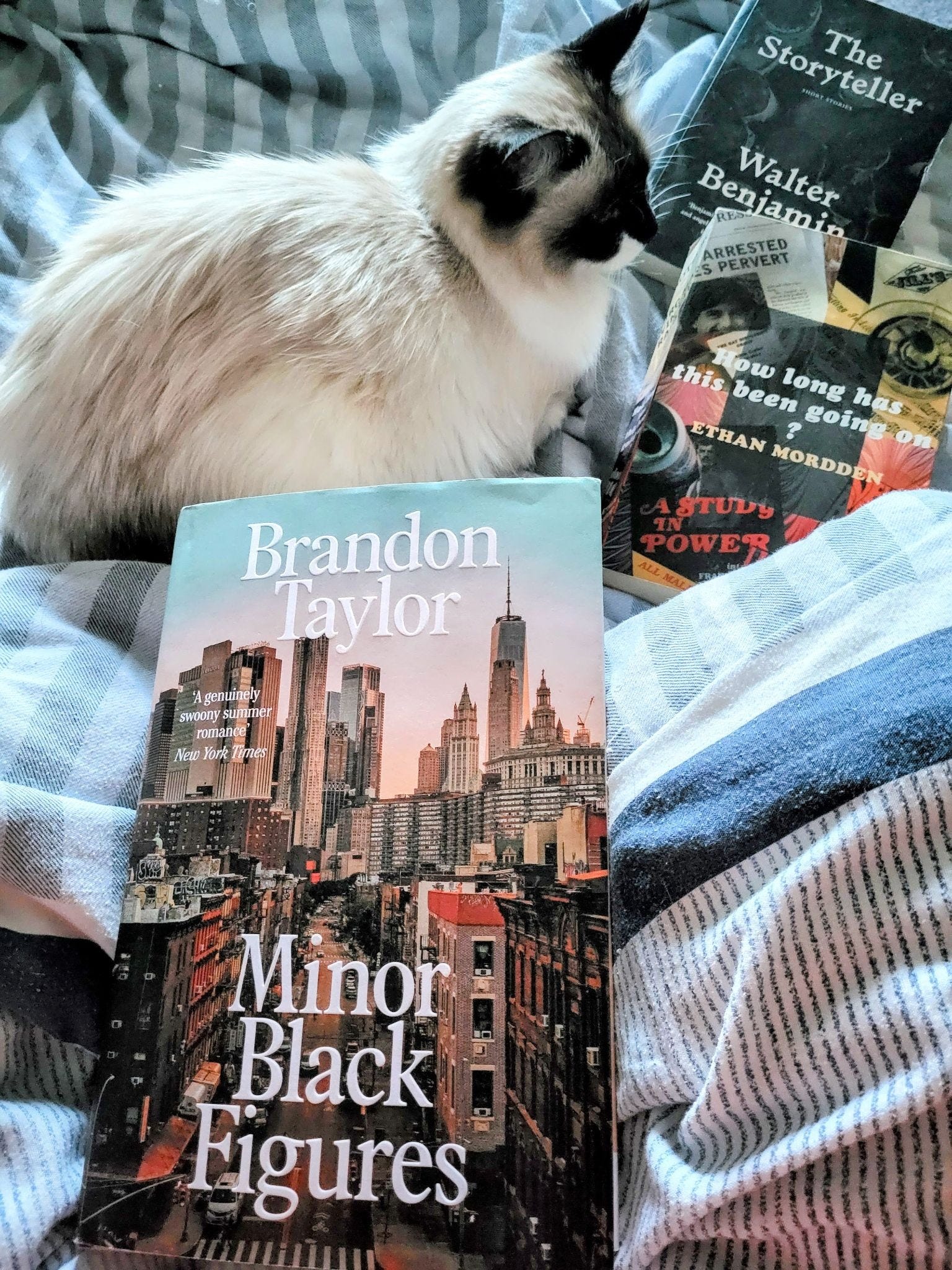
Set in a post-pandemic New York where Wyeth, a Black artist, falls into a romance with Keating, a former priest, Minor Black Figures comfortably inhabits its position of being a novel of its time while also asking timeless questions about what it means to be an artist and how we mediate our identities. It’s filled with terrific sensory details and embedded with deep interiority (my Henry James-loving heart is delighted) as Wyeth wrestles with and tries to control how he and his art are perceived by the world. In other words, it is my kind of literary fiction—sophisticated and intelligent yet accessible to someone like me who isn’t a literary bro, and powerful enough to stay with me long after I’ve read it. For the last few days, I’ve been in a celebratory mood, having been imbued with this feeling that as long as great literature is still within our reach—meaning, traditional publishers are still investing in the works of writers who can actually write—literature will be fine.
Or will it?
When I consider the decline in literacy and reading enjoyment levels in several countries, as well as in the university-level engagement in literary studies, I can’t help but worry about how the literary landscape will look many years from now. Will high- and middle-brow literature be confined to the realms of literary circles populated by the authors of such literature and the last holdouts of dying English Literature departments? Will Booktok and Booktube—in whatever forms they will exist in the future—become the permanent, final arbiters of taste for a generation of readers who have been denied the opportunity to develop literary sensibilities that will drive them towards more intellectual reading choices?
I’m looking at the literacy levels in my birthplace. According to this report in 2024, although 90 percent of Filipinos were functionally literate, 30 percent of them couldn’t comprehend what they read. As someone who was raised to love books by parents who didn’t even finish high school, I am heartbroken by this. Among young Filipinos who do read for pleasure, the practice of reading is inextricably linked to their use of social media. And, like other Gen Z readers in Southeast Asia (and most likely everywhere else), they seem to enjoy a lot of fan fiction on Wattpad and AO3.
Of course, in places like the Philippines, accessibility is an issue. Physical books are expensive, public libraries are not as accessible as they are here in the UK, and people’s time is taken up by long daily commutes to their places of study or work. Fan fiction is free and readily available, hence its popularity among young Filipino readers.
I’m usually not fazed by young readers’ obsession with fan fiction. Reading is reading, after all, and I do understand the comfort that these readers find in stories with predictable narratives and characters who are already familiar to them. But I do get worried when I see declarations like this:
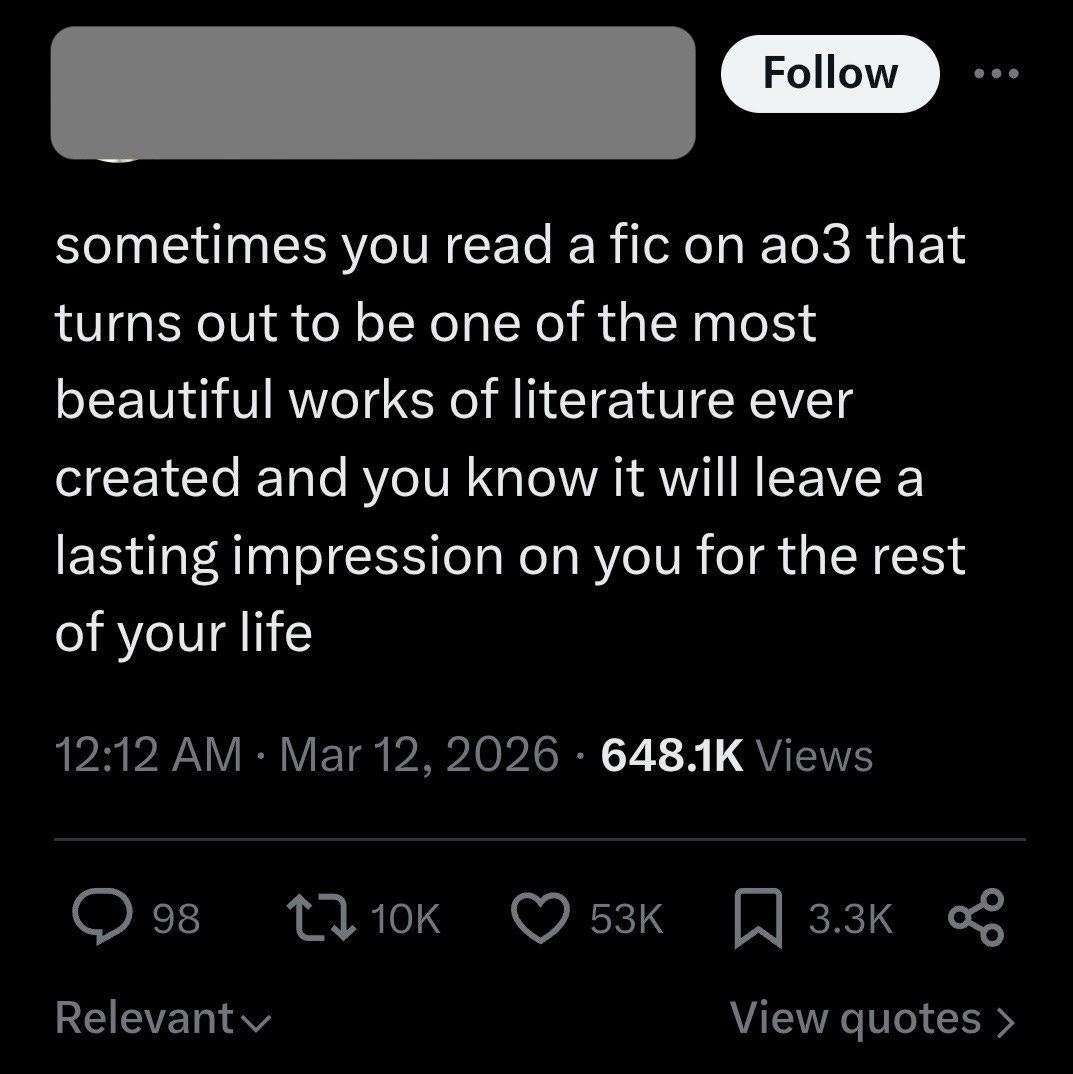
The fiction referred to in the post turned out to be smut that was drawn heavily from the infamous scene involving a peach in André Aciman’s Call Me by Your Name. (Yes, I just had to go to AO3 and read it.) Look at the number of likes on that post. Even more concerning are quotes like this:
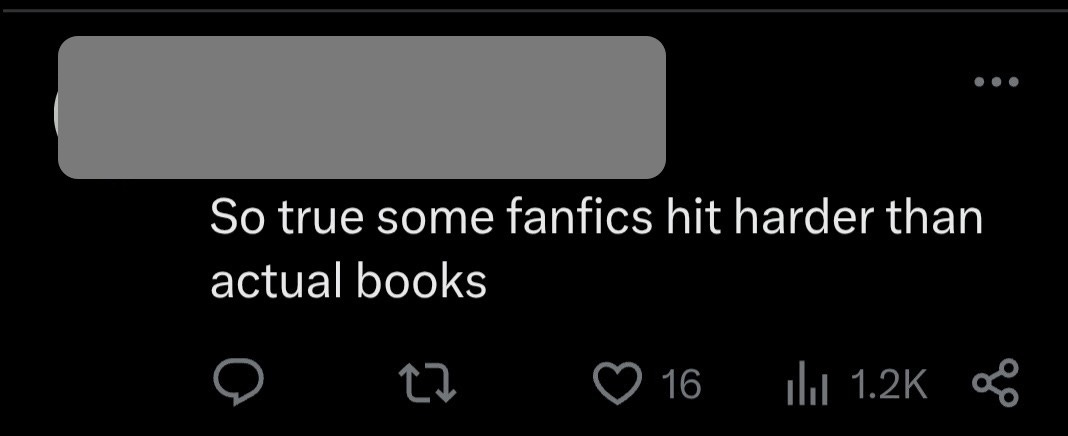
It’s easy to see why many fan fiction readers are not keen on literary fiction. It tends to defy the established tropes and doesn’t hit the story beats that they’re used to seeing in fan fiction. But how can we expect them to appreciate ‘actual books’ if (a) they don’t have ready access to higher forms of literature and (b) they’re not given the literacy training that will help them develop a taste for these types of literature?
The onslaught of AI doesn’t help. Neither do pieces like this from the New York Times, the point of which I’m still struggling to see. Why put AI-written text alongside a human-written one and ask readers to compare them on such a narrow parameter (which text reads better)? Given that the human-written bits of text were excerpted from books (a 371-word poem in the case of the poetry comparison), it was illogical to put them next to AI-generated text without any context or consideration for the voice in which they were written and the stylistic choices made by their authors.
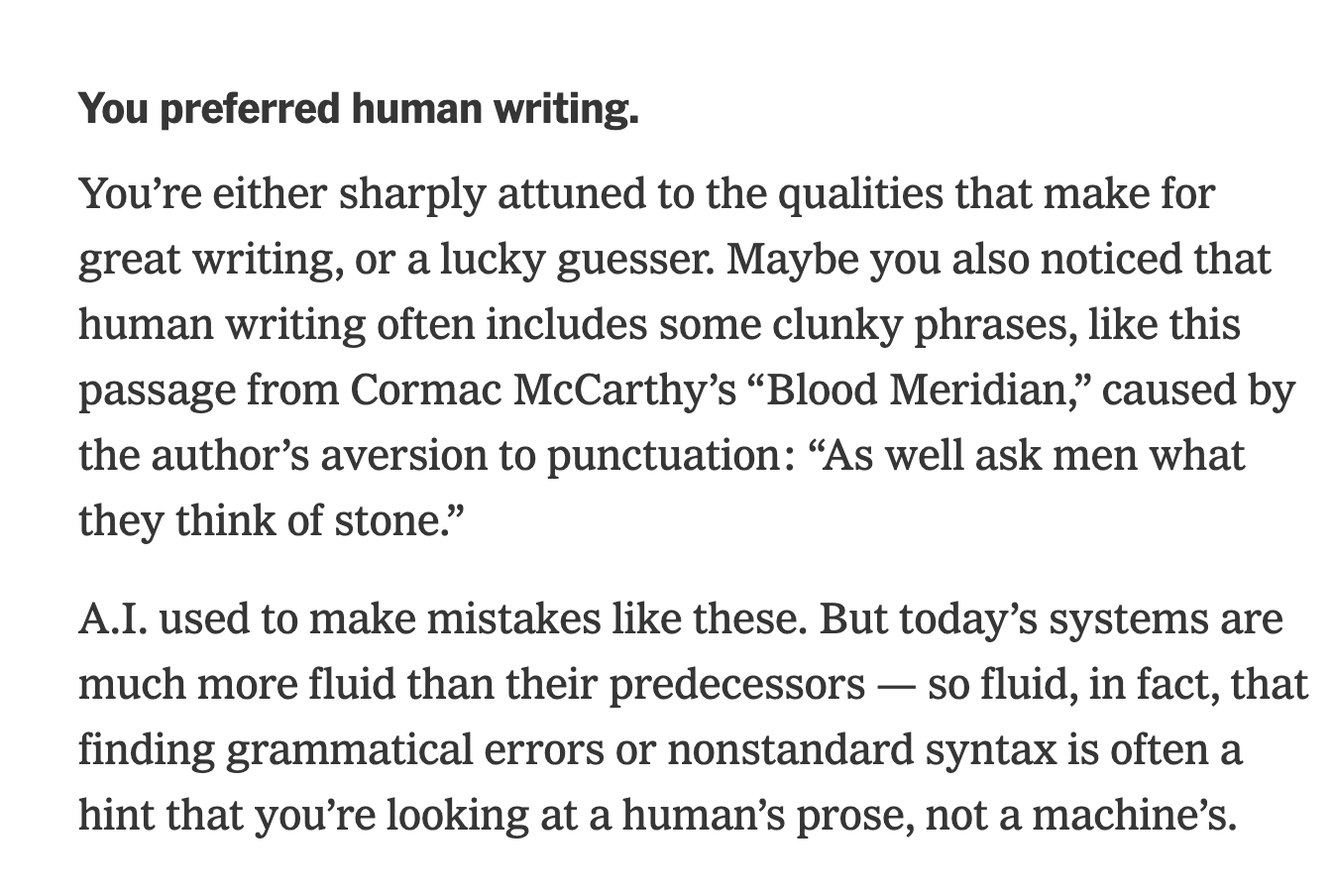
What exactly is this quiz trying to achieve? Is NYT telling us that genAI is so good now that it can make writing giants like McCarthy, Le Guin, Mantel, Sagan and Bishop look like amateurs with their ‘clunky phrases’ and ‘nonstandard syntax’? (The irony is that Le Guin’s estate has been involved in a class action lawsuit against Anthropic, the maker of Claude which was used in this quiz, for having trained its LLM without permission on hundreds of thousands of books, including 40 of Le Guin’s.) What does it want to say about complex literary works crafted by highly skilled and experienced humans as opposed to grammatically correct but artifice-laden and essentially empty AI writing produced by statistical correlations? Is there even any valid point of comparison between slop and literature?
In January, this book review by Frankie’s Shelf went viral. The video, which is almost half the average length of a Lav Diaz film, focuses on Mia Ballard’s Shy Girl, a novel that tries to chase the femgore trend started by Eliza Clark’s Boy Parts in 2020. The review dissects the novel and criticises it not just for its questionable plot and narrative but also for how many parts of it read like they were written by AI. (Ballard denied the accusation, of course. I’d like to give her the benefit of the doubt, but an author is ultimately responsible for the final contents of their book. Blaming the insertion of AI-written parts on one’s editor is unacceptable and dubious. Also, look at this Q&A that she did while promoting the book and where her written responses also come across as, well, AI generated.)
The book was originally self-published, and I think most people would probably have just left it alone had it not been for the fact that it was acquired and published by Wildfire, a Headline UK imprint. What does it say about the future of literature when a traditional publisher picks up a novel containing large chunks of AI-generated text? And if booksellers are willing to carry AI-written titles, what does the future hold for real writers when their books have to compete for shelf space with AI-written ones? Sure, Waterstones managing director James Daunt says AI-written books will have to be clearly labelled as such, but having seen what happened with Shy Girl, can we really expect publishers to take this responsibility seriously if their priority is their bottom line?
Who then is responsible for separating literature from slop? Is it the readers whose inclination towards reading for pleasure and taste for literature are on the wane? Or is it the publishers who want to make bank by riding on trends dictated by social media algorithms?
When I try to look for answers, I end up thinking about my kids instead. They were both avid readers when they were in primary school and in the beginning of secondary school. When they started preparing for their GCSEs, however, their reading habits changed because they were now being taught to approach literature not as people who enjoyed reading but as examinees who needed to be able to write essays about specific bits of text and ensure each essay hit the required number of ‘marks.’ Literature had been reduced to yet another set of information to be mined and mastered for that highly prized A*.
In the three years that he was at uni, my son never picked up a book to read just for fun. Pre-university exams had sucked the joy out of reading for him. My daughter, trained to read short, hollowed-out versions of ‘difficult’ books, discovered webtoons and started favouring them over her physical books.
Last year, I asked my son about what he would like to read if he were to take up reading as a hobby again. He said he had always enjoyed fantasy, so I lent him my copy of Terry Pratchett’s Going Postal. He finished it after a few weeks and was eager to read more books in the series. So we went through the list of all the Discworld novels and I bought several titles for him. He’s currently reading Mort, slowly but with genuine pleasure.
When my daughter started watching the Interview with the Vampire series on Netflix, I asked her if she would like to read the books. She was reading the first book all throughout the Christmas holidays. A queer fiction fan, she’s now looking forward to reading Madeline Miller’s Song of Achilles.
I often feel like I’m locked in a constant battle for my children’s literary souls. It’s hardly a fair fight when social media, low-effort online content and streaming platforms have overwhelming appeal and far-reaching influence. So every time I do see one of them reading a book and—in my daughter’s case—even writing and illustrating their own stories, I’m grateful for being able to notch up yet another tiny victory against slop.